Openers · Cliffcrest
Belt-Drive Opener Repair in Cliffcrest
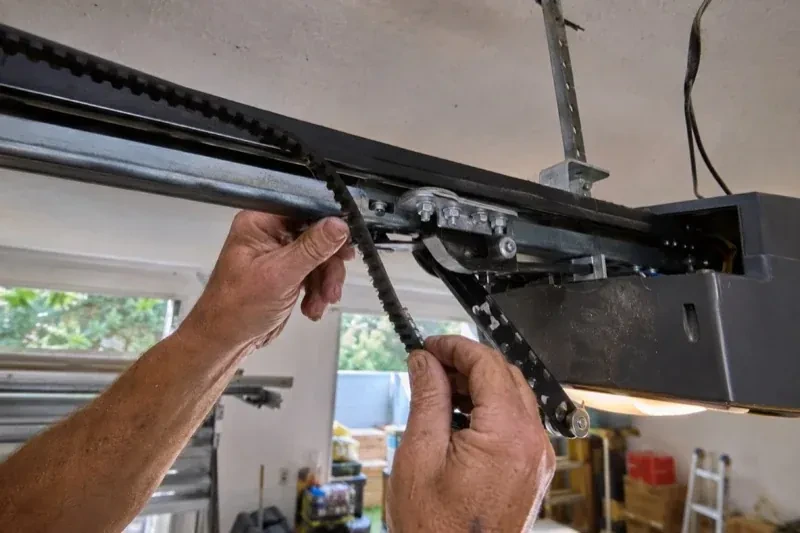
Press the remote and the motor runs its full cycle, lights on, the usual whir, but the door does not move a centimetre. Up at the trolley, the belt is hanging loose where a small plastic clip used to hold it.
Belt-Drive Opener Repair
In plain words
A belt drive is chosen for its quiet, so one that has started to rattle is saying something specific. Sprocket noise usually means the belt is either too loose or too tight. A squeal from the front of the rail points to the idler pulley bearing. A clack at the same point in every cycle is a run of worn teeth or a rail joint out of line. A hum with no movement is a broken clip, a stripped gear or a belt off its sprocket. Repair means reading those sounds, confirming them by inspection and replacing the one component responsible, so the operator returns to its hush.
How the visit goesThe door used to glide up with a soft hum. Now there is a sharp clack every second or so, and if you stand underneath you can see the belt sagging below the rail and slapping it on the way up.
Cliffcrest
How the visit goes
The trolley and its release
The trolley turns the belt's pull into movement of the door and takes every start and stop. The technician checks its two halves: the inner half the belt is fixed to, and the outer half the door arm hangs from. The release lever should part them cleanly when the cord is pulled and lock them together again when the operator runs or the cord is pulled a second time. Cracks in the housing, a lever gummed with old grease, play on the rail, or a trolley sitting hard against a stop bolt are all noted. Whether trolley and motor are in step is checked too, since a belt that has been off the sprocket often leaves them disagreeing.
Replacing the trolley
A cracked, worn or stuck trolley is removed by unclipping the belt, unhooking the door arm and sliding the assembly off the end of the rail, which on many models means loosening the rail at the header bracket first. The new trolley slides on, the belt is reconnected with a fresh clip, the tension spring and square nut are set, and the door arm is pinned back to the outer half. The technician works the release lever several times to be sure the halves part and lock as they should, then runs the door by motor. Play between trolley and rail is checked, since a loose trolley rattles and wears the belt edge.
The red cord, and what to do after you pull it
You now know where the release handle hangs and what happens when you use it. A pull parts the trolley so the door can be lifted by hand through a power cut; running the motor, or a second pull, reconnects it. What matters after this repair is to pull it only with the door closed. Releasing a door that is open, or one whose springs are tired, can let it fall because the spring no longer carries its weight; the release itself disconnects the trolley from the belt, so the falling door lands on its tracks and hinges, not the belt the technician just corrected. Practise it once with the door down so the first real use is calm.
Belt-Drive Opener Repair
In the van
- Photo-eye sensor pair
- Garage-door lubricant for hinges and rollers
- Reinforced drive belt with clip
- Idler pulley and bearing
- Inner and outer trolley
What affects the quote
Same fees day, night or weekend
1Rail straightening or re-hanging
A bent rail, a sagging hanger or a misaligned rail joint that has been fraying the belt is corrected as part of the repair so the new belt runs clean, and the labour appears on the quote.
2How far the technician drives
A garage on the edge of town and one down a long rural road take different time to reach, and that trip is a line of the quote.
3Detached or unheated garage
A cold garage still gets the belt tensioned to the maker's specified measurement, but calls for a cold-rated lubricant on the door hardware, a small item that a winter quote names.
Belt-Drive Opener Repair: questions
How long does a belt-drive repair take?
A tension adjustment with the safety tests is a short visit. Replacing the belt, trolley or idler pulley, then phasing the motor, relearning limits and running the reversal tests, is usually an hour or two. A gear-and-sprocket kit at the motor head takes longer because the head unit is opened. If the balance test turns up spring work, that is agreed as a separate job with its own time.
Should the belt be lubricated?
No. The belt is meant to run clean and dry; oils and sprays soften the rubber and gather grit in the teeth, which wears the sprocket. Lubricant belongs on the door instead: hinges, rollers and springs get a garage-door lubricant once a year. The gear inside the motor head takes a light grease when it is serviced, and that is the technician's job.
How often should belt tension be checked?
A look every few months is enough: with the door closed and again with it open, the belt should run level with no sag below the rail. A yearly service that checks tension against the spring length, looks at the sprocket and pulley and runs the balance and reversal tests keeps a belt drive quiet for its whole life. Check again after the first hard cold of the winter.
Openers & Access
- Chain-Drive Opener RepairPress the button and the opener hums for a second, then quits.
- Garage Door Opener ReplacementThe bedroom above the garage shakes every morning at six when the chain drive fires up.
- Photo-Eye Sensor Alignment or ReplacementAfter a cold night the door stays open until the garage warms up.
Belt-Drive Opener Repair near you
In Cliffcrest we work on garage doors of every age and size: single and double residential doors, insulated and uninsulated, wood and steel, plus commercial rolling and sectional doors. The service pages explain the repairs, replacements and installations that apply to each.