Springs · Toronto
Garage Door Hinge Replacement
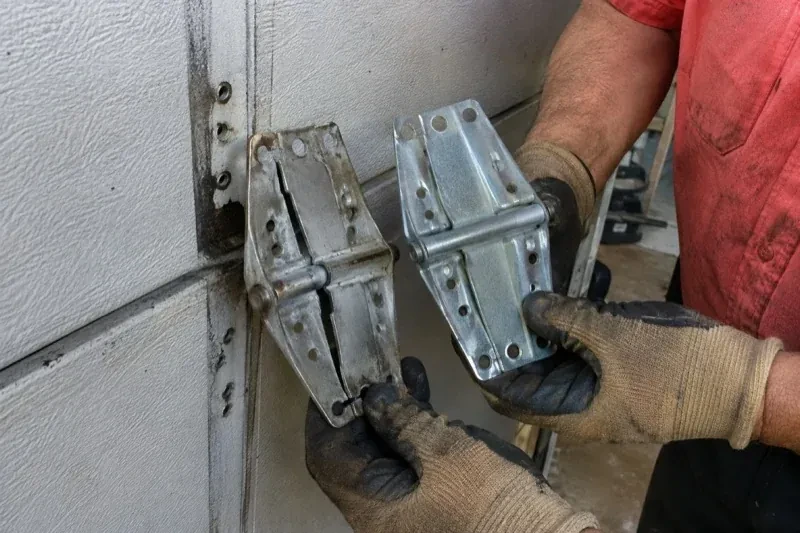
With the door closed and a flashlight on the inside face, one of the hinges near the edge has a crack running from the screw hole to the knuckle. The steel around it is brown with rust, and the pin looks loose in its barrel.
Garage Door Hinge Replacement
In plain words
Hinges are the joints of a sectional garage door. Each pair of panels is connected by two hinges at the edges, which also hold the rollers, and by one or more centre hinges along the middle. Hinge replacement removes a hinge that has cracked, bent, worn loose at the pin or lost its grip on the panel and fits a matching one in its place. The technician keeps the door closed and the opener disconnected, changes each hinge on its own, checks the panels line up and the rollers sit true, and runs the door to confirm it folds around the curve as one piece.
How the visit goesOn the old wood door, one hinge has pulled away from the panel, dragging a screw and a chunk of soft timber with it. The panel sags slightly at that joint and the door bumps at the curve instead of gliding.
Toronto
How the visit goes
The rollers the hinges carry
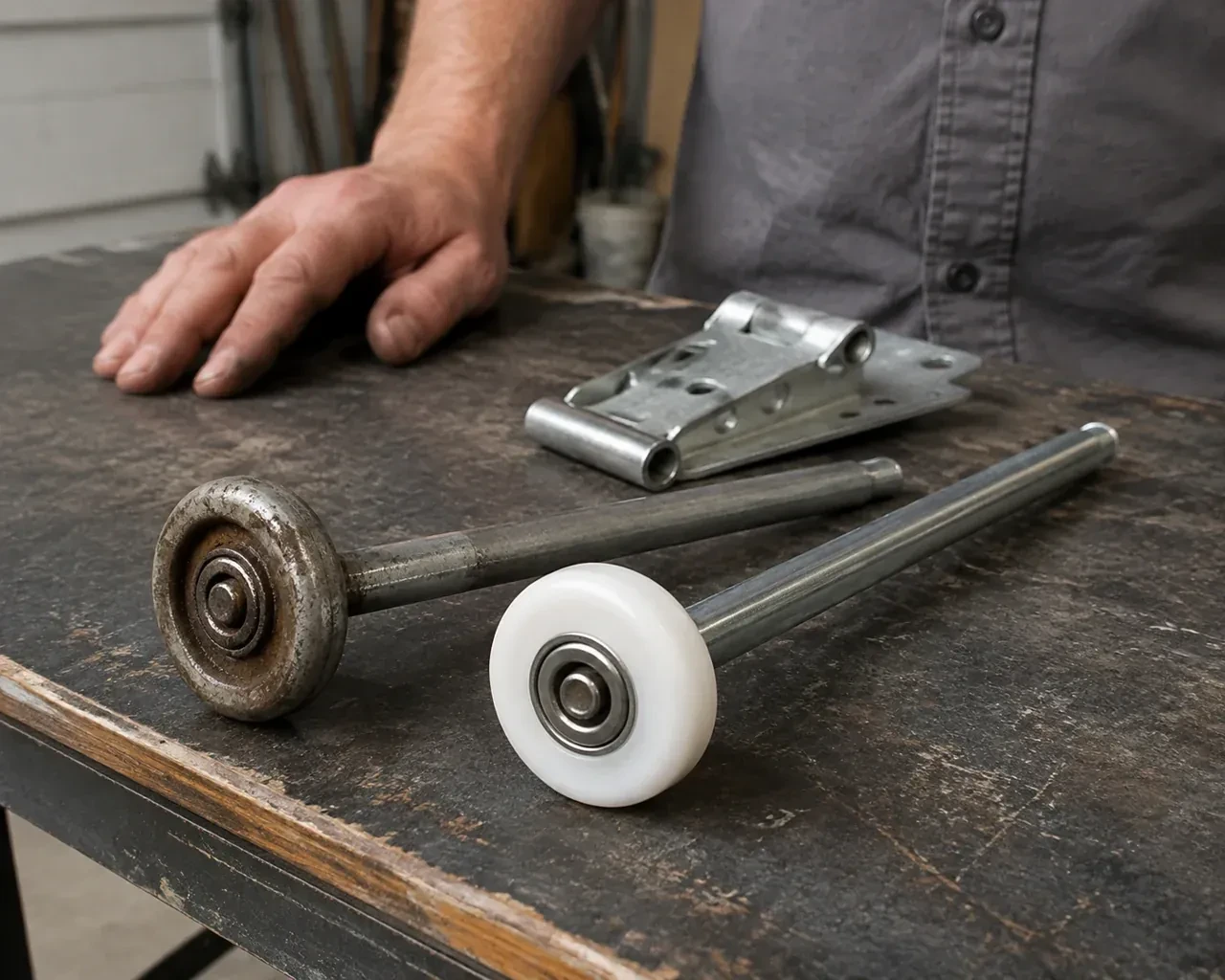
Each edge hinge cradles a roller stem, and the two wear together. The technician spins every wheel, looks for cracked or flat-spotted tires, checks that the stem has the right length for the hinge it sits in and that the bearing turns without grinding. A roller that has seized drags at the hinge on every trip, and a stem that is too short lets the wheel wander out of the track and twist the hinge. Where rollers are worn, changing them while the hinge is off costs a few minutes and stops the new hinge inheriting the strain that finished the old one.
Hinge work after an impact
When a bumper or a bin has hit the door, the hinge is often bent along with the stile behind it. The technician removes the damaged hinge, straightens the stile with a dolly or fits a support plate where the steel has creased, and checks that the panel edges no longer touch when the joint flexes. A strut is added or straightened if the panel has bowed. The new edge hinge goes on with its roller, and the door is run through the curve by hand to confirm the panels turn without rubbing. Where a section itself is buckled, that is discussed as a separate decision.
A monthly look from the inside
The maintenance checklist the door industry publishes asks homeowners to check hinges, brackets and fasteners visually from inside with the door closed, once a month. Stand where you can see both ends of the door and follow each joint with a flashlight: a screw head that stands proud, a hinge leaf lifted off the panel, a fresh crack spreading from a hole, or a rust stain running down from a knuckle. Then watch the door open and confirm the rollers stay in the track. Anything you spot is a small job at that stage. The whole check takes about a minute.
Garage Door Hinge Replacement
In the van
- Hinge support plates
- Flashlight and level
- Numbered galvanized edge hinges
- Hex-head self-drilling screws
- Centre hinges
What affects the quote
Same fees day, night or weekend
1Door width and panel count
A tall or double door has more joints and more hinges per joint, so a full-door hinge refresh on a double is a bigger job than the same work on a single.
2Supporting the panel while hinges are changed
A heavy insulated panel needs to be braced while its hinges are off, so it does not sag or twist out of place mid-repair. Lighter steel or wood panels usually need no extra support, and the technician decides which applies once the panel is in front of them.
3Corrosion and seized fasteners
Screws rusted solid take time to drill out, and heavily corroded hinges on the lower joints are replaced rather than reused, which shows in the parts list.
Garage Door Hinge Replacement: questions
Will new hinges make the door quieter?
Often noticeably. A cracked or loose hinge is the source of many pops, clicks and rattles, and a hinge that holds its roller square lets the wheel run flat instead of scraping the track lip. Combined with fresh lubricant on the knuckles and rollers, the door settles into a steady rumble. Any noise that remains usually points to the rollers, the opener chain or the springs, which the technician can identify for you.
Can I tighten loose hinge screws myself?
Yes, hinge screws are a homeowner task. Disconnect the opener, leave the door closed, and snug each hinge screw with a socket wrench without forcing it, since overtightening strips the hole. Leave the bottom brackets alone; they anchor the cables and are under spring tension. If a screw spins freely or a hinge is cracked, stop there and have it looked at, because a stripped hole needs a fresh anchor rather than more turns.
Can any hinge go in any position?
Edge hinges belong to their own joint. Put a 3 where a 2 belongs and the roller sits at the wrong reach, so the door binds, gaps at the curve or fails to press against the jamb when closed. Centre hinges are the exception, since they all share the geometry of a 1. The technician reads the stamp on the old hinge or counts the joint from the floor before choosing the part.
Springs & Hardware
- Garage Door Track Repair or ReplacementThe garage floor has settled at one corner, and the door now scrapes the concrete on that side…
- Garage Door Cable ReplacementYour older door has springs along the tracks, and one cable has slipped off its pulley and dangles…
- Torsion Spring ReplacementNothing broke outright, but the door has grown heavier each winter, opens more slowly and squeals…
Garage Door Hinge Replacement near you
The garage door services we bring to Toronto fall into four groups: repair and maintenance for doors that are sticking or noisy; springs and lifting hardware; openers, remotes and access; and new door installation or upgrade for homes and businesses that are ready for a change.